There is a specific kind of satisfaction that comes from opening a pantry that is genuinely organized. Not just tidied in a hurry before someone comes over, but actually organized in a way that makes sense, looks beautiful, and functions perfectly every single time you open the door. The kind of pantry that makes cooking feel like a pleasure rather than a scavenger hunt through half-open bags and expired cans stacked three deep behind things you forgot you owned.
The Pinterest-worthy pantry that most people scroll past and save to a board they never revisit feels aspirational to the point of being unrealistic. The truth is that the most beautiful and functional pantries are not the result of expensive custom cabinetry or a complete kitchen renovation. They are the result of a specific organizing philosophy applied consistently with a handful of affordable tools and a few hours of focused effort.
And when that organizing philosophy is built around sustainable principles, the pantry you end up with is not only beautiful and functional but also genuinely better for the environment, better for your budget, and better for your health than the conventional alternative.
This guide walks you through the entire process from empty shelves to finished pantry so you can build the sustainable pantry of your dreams regardless of the size of your space or your budget.
Start by Taking Everything Out
There is no shortcut to this step and no way to properly organize a pantry without doing it. Everything comes out. Every can, every bag, every jar, every box, every forgotten spice, every mystery item from the back of the shelf that you cannot quite identify. All of it comes out and goes onto your counter or kitchen table where you can see it clearly.
As you empty the shelves sort everything into three categories. Food that is still good and will go back in. Food that is expired or so old you genuinely cannot be confident about it. And food that is still good but that you are realistically never going to eat, which can be donated to a local food bank rather than sitting in your pantry for another year before eventually being thrown away.
This initial sort is itself a profoundly eco-friendly act. Food that gets donated gets eaten rather than wasted. Food that is identified as expired gets composted rather than left to take up space and eventually be discovered during a future cleaning when it has gotten even worse. And the realistic assessment of what you actually eat versus what you buy out of good intentions prevents future purchases of things you already know will just sit there.
Wipe down every shelf thoroughly with your natural white vinegar cleaning spray while the shelves are empty. This is the only time you will have clear access to every surface and it is the right moment to give the whole pantry a genuinely deep clean. Let the shelves dry completely before putting anything back.
Understand What You Actually Eat
Before buying a single organizing product or container, spend a few minutes looking at what came out of your pantry with honest eyes. What categories of food do you actually cook with regularly? Which ingredients show up in your weekly meals consistently? Which items have been sitting untouched for six months?
Understanding your actual eating patterns rather than your aspirational ones is the foundation of a pantry that stays organized long term. A pantry organized around the foods you actually cook is naturally easier to maintain than one organized around a theoretical version of your eating habits.
If you have sixteen different spices but only cook with five of them regularly, your spice organization system needs to prioritize those five. If you have four different types of grain but only cook rice and oats consistently, your grain storage should make those two most accessible. The pantry should be organized around your real life, not an idealized version of it.
This understanding also informs how much storage space each category needs, which is essential information before you start assigning categories to shelf locations and buying containers in specific quantities.
Assign Zones Before Buying Anything
Once you know what you have and what you actually use, the next step is to assign dedicated zones within your pantry before purchasing a single organizing product. Zones are the categories of food that will live in specific areas of your pantry based on two principles: frequency of use and logical grouping.
Items you use every single day should live at eye level where they are most visible and most accessible without any reaching or searching. For most kitchens this includes staple grains like rice, oats, and pasta, everyday cooking oils and vinegars if stored in the pantry, frequently used spices, and snacks and grab-and-go items.
Items used regularly but not daily go on the shelves directly above and below eye level. This typically includes baking ingredients, canned goods, dried beans and legumes, nuts and seeds, and less frequently used condiments and sauces.
Items used occasionally or in bulk go on the highest and lowest shelves where they are less immediately accessible. Large backup supplies, specialty ingredients used only for specific recipes, and seasonal items like holiday baking supplies all belong here.
Assigning zones before buying organizing products prevents the common mistake of buying a beautiful set of uniform canisters and then discovering they do not fit the shelves correctly or that you bought the wrong quantities for your actual needs.
Choose Sustainable Storage Containers
This is where the pantry starts to look like a Pinterest board and also where most people spend more money than they need to. The good news is that the most sustainable pantry storage options are also among the most affordable and most beautiful available.
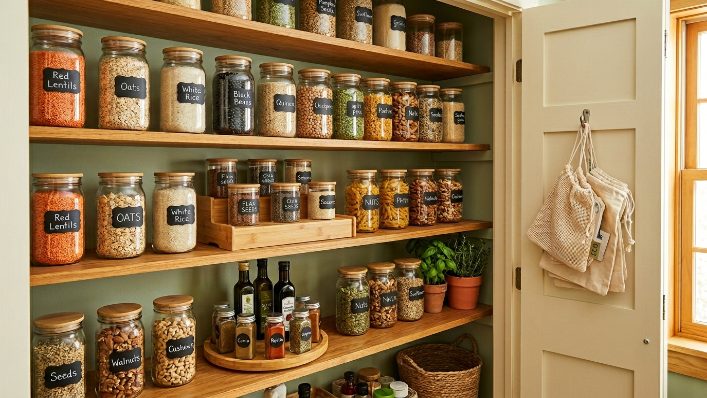
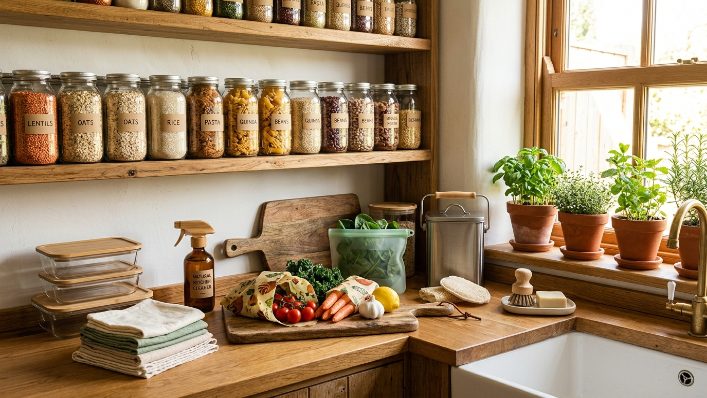
Glass jars are the foundation of any sustainable and aesthetic pantry. Wide mouth mason jars in pint and quart sizes store virtually every dry pantry good including grains, pasta, rice, dried beans, lentils, nuts, seeds, dried fruit, sugar, flour, and countless other staples. They are completely airtight when sealed properly, completely transparent so you can see exactly what and how much is inside at a glance, free of any chemicals that could transfer to your food, and genuinely beautiful when lined up together on a shelf.
The most sustainable approach to building your glass jar collection is to start with what you already have. Pasta sauce jars, jam jars, pickle jars, and any other glass jars with lids that come into your kitchen through normal food purchases can be cleaned and repurposed as pantry storage containers at zero cost. They will not match perfectly but a shelf of assorted glass jars filled with colorful pantry staples has its own rustic and charming aesthetic that many people find more appealing than a perfectly uniform commercial set.
If you want a more uniform look, wide mouth mason jars are the most affordable option for building a matching collection. A dozen quart mason jars costs around ten to fifteen dollars. A dozen pint jars costs around eight to twelve dollars. These will outlast any commercial food storage container on the market and look better on a shelf than any plastic alternative.
For items that do not need to be in glass, like large backup supplies of flour or sugar stored in quantity, food grade stainless steel containers or large ceramic crocks are beautiful and sustainable alternatives to plastic bins. Look for these at thrift stores where they appear regularly at a fraction of their retail price.
Avoid buying new plastic containers for your pantry even clear ones that are designed to look like glass. Plastic containers scratch over time becoming cloudy and less attractive. They can harbor odors and off-gas into food especially when storing items long-term. And they eventually crack and need replacing, generating plastic waste and requiring further purchase. The slightly higher upfront cost of glass is a genuinely better investment by every measure.
Label Everything Clearly and Sustainably
Labels are what take a pantry from organized to genuinely useful and from nice-looking to actually beautiful. When every jar and container is clearly labeled you can find any ingredient instantly without opening multiple containers and you can see at a glance when something is running low and needs to be added to the shopping list.
The most sustainable labeling approach avoids adhesive plastic labels that leave residue and generate waste every time you change the contents of a container. Chalkboard labels made from paper with a chalk or chalk pen writing surface are a popular option that looks beautiful, writes clearly, and can be wiped clean and rewritten when the contents of a container change. They are widely available in packs of twenty to thirty for a few dollars.
A paint pen or chalk marker used to write directly on the lid of mason jars is another completely waste-free labeling approach. Write the contents on the lid in chalk marker, which wipes off easily with a damp cloth when you want to change it. This approach requires no additional label product at all.
For a more permanent labeling solution, small pieces of washi tape written on with a fine tip marker are removable, repositionable, and available in beautiful natural colors and patterns that add to the aesthetic of the pantry without generating any meaningful waste.
Whatever labeling system you choose the key information to include is the name of the contents and if relevant the date you decanted the food into the container so you always know how long it has been there.
Decant Strategically Not Obsessively
Decanting, which means transferring food from its original packaging into your glass jars and containers, is the single most visually impactful step in building a Pinterest-worthy pantry. When the food in your pantry lives in uniform containers rather than a mix of original packaging in different sizes, colors, and styles, the visual harmony of the whole space increases dramatically.
But decanting everything is not always the most sustainable approach. Some original food packaging is designed to keep specific foods fresher longer than a glass jar would. Some items are used so quickly that decanting them adds effort without meaningful benefit. And some packaging, like paper bags for flour or cardboard boxes for cereal, is itself relatively sustainable and does not necessarily need to be replaced with a glass container.
Decant items that come in plastic packaging first since removing food from plastic storage into glass reduces both visual clutter and chemical exposure. Decant items that you use frequently enough that seeing the quantity at a glance saves you from accidental duplicate purchases at the grocery store. And decant items that genuinely look beautiful in a glass jar, which is most things.
Items that can stay in their original packaging include things in genuinely sustainable packaging like paper bags or cardboard boxes, items used very infrequently where the original sealed packaging keeps them fresher than an opened glass jar would, and large bulk quantities where you decant into a smaller accessible jar and store the bulk backup supply in its original packaging at the back of a lower shelf.
Use Shelf Risers and Turntables for Depth
One of the most common pantry problems is depth. Most pantry shelves are deep enough that items at the back become invisible and effectively inaccessible leading to the forgotten food problem that drives a significant portion of household food waste. Two simple and inexpensive tools solve this problem completely.
Shelf risers create a stepped display within your pantry shelf so that items at the back are elevated above items at the front and visible without moving anything. Look for shelf risers made from bamboo or natural wood rather than plastic. They cost between ten and twenty dollars for a set and immediately make the full depth of your shelves visible and usable.
Lazy Susans or turntable organizers placed on shelves allow you to spin the contents to access items at the back without reaching or rearranging. They are particularly useful for oils, vinegars, and condiments stored in the pantry, for spice collections, and for any shelf where you consistently struggle to access items at the back. Look for turntables made from bamboo or stainless steel rather than plastic for the most sustainable and durable option.
These two tools together transform a deep pantry shelf from a space where food goes to be forgotten into one where every item is visible, accessible, and regularly rotated into use.
Implement a First In First Out System
A beautiful organized pantry is only genuinely sustainable if it also reduces food waste, and the most effective tool for reducing pantry food waste is a simple inventory management principle borrowed from commercial food service. First in first out means that when you bring new food home from the grocery store you place it behind whatever quantity of that item already exists in your pantry so that the older stock always gets used before the newer stock.
This requires building your pantry storage in a way that makes this rotation easy. For jars stored in rows, newer stock goes at the back and older stock stays at the front. For cans stored in rows the same principle applies. Some dedicated can organizers are designed specifically to automate this rotation by feeding cans in from the top and dispensing them from the bottom, ensuring perfect first in first out rotation without any manual effort.
Practicing first in first out consistently means that nothing ever gets pushed to the back and forgotten until it expires. Every item in your pantry is always working its way toward the front and toward being used, which means that buying reasonable quantities during sales and stocking up on staples can be done without the risk of things expiring before they get used.
Keep a Running Pantry Inventory
The final habit that keeps a sustainable pantry functioning beautifully over the long term is maintaining a simple running inventory of what you have and what you are running low on. This does not need to be complicated. A small chalkboard or whiteboard mounted on the inside of the pantry door, a simple notes app on your phone, or a paper list kept on the fridge all serve the purpose equally well.
When you use the last of something or notice that a container is getting low, add it to the list immediately rather than relying on memory. Before each grocery shop review the list and buy only what is genuinely needed rather than what you think might be running low. This habit prevents both the frustration of running out of staples mid-cooking and the waste of buying duplicates of things you already have in adequate supply.
A pantry inventory also makes it easy to plan meals around what you already have rather than defaulting to buying all new ingredients for every recipe. When you can see clearly that you have half a bag of red lentils, a can of coconut milk, and various aromatics, a lentil curry becomes an obvious dinner choice that uses what is already there rather than adding to what needs to be stored.
The Pantry That Earns Its Pinterest Board
The sustainable pantry you build following this guide will earn its place on any Pinterest board not because it was assembled using expensive products or professional organization services but because it reflects something more appealing than either of those things. It reflects genuine intention.
A pantry where every item has a place, every container is chosen thoughtfully, every label is clear, and every habit supports both beautiful function and minimal waste is a pantry that communicates something true about how you live in your kitchen. It says that you cook with care, that you value what you have, that you waste as little as possible, and that you have found a way to make the practical beautiful.
That combination of practical and beautiful, of sustainable and aesthetic, of organized and lived-in is exactly what the best Pinterest boards are actually trying to capture. And the version you build in your own kitchen, with your own jars and your own ingredients and your own labels in your own handwriting, will be better than any image on a screen because it will be real and it will be yours.